All the Right Foods

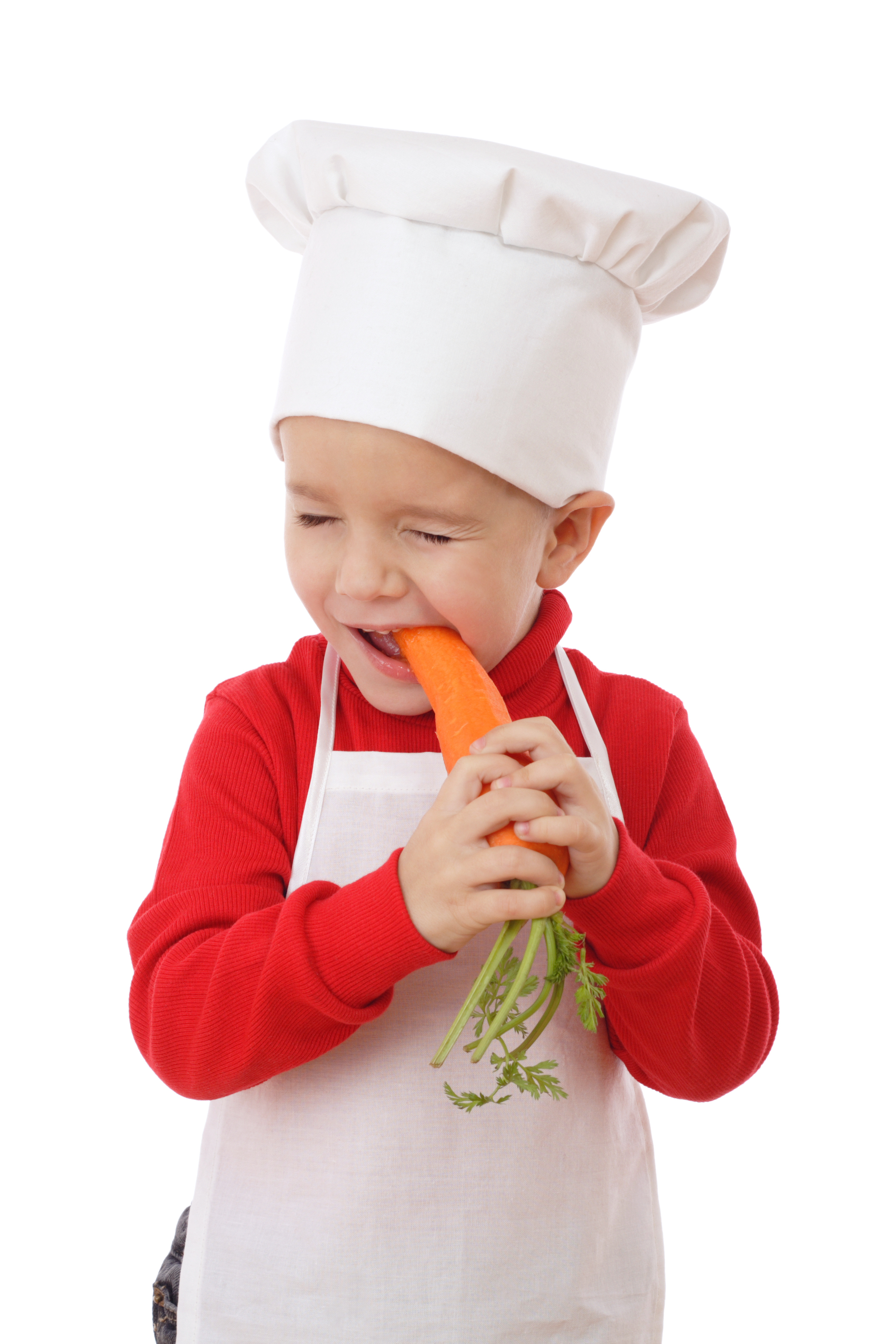
Little chief-cook tasting the carrot isolated on white

One of my favorite teachers once said “Never fight a battle with a child that you cannot win.” Excellent, timeless advice.

Luckily, children are young and inexperienced. We adults are old and treacherous–we can outsmart them.

This is particularly good advice when it comes to nourishing a child. The grown ups need to win food battles, because the losing side is populated with joint pain, back pain, heart disease, stroke and death. We have to set up this battle so that we cannot lose, because otherwise our child will suffer.

There are two keys to making this work.

The first is that children do not cry for what they don’t know exists. A three year old who doesn’t know about chicken nuggets and French fries does not beg for them. If it’s not too late, start on day one and keep only healthy food in the house, in the proportions you want them to consume. Eat at home. Then let them have it. Everything in the house is good for them, so you never have any arguments over what your urchins can or cannot eat. If they munch on healthy snacks throughout the day, like whole grain crackers with cheese or pieces of fruit or veggies, it really doesn’t matter if they eat formal meals.  There is no need to argue over what they need to eat before they leave the table.

If it is too late and they already have some bad habits, explain to them that you’re turning over a new leaf, eating healthier, and throwing out all the junk. Then do it, and put in earplugs. It gets better in about two weeks if you are consistent and don’t give in.

The second key is that “never” is a lot easier for a child to deal with than “sometimes.” “Never” is a shake of the head, a smile, and a change of subject. “Sometimes” is endless daily arguments over what they want today because sometimes they get it, sometimes you buy it, sometimes it’s O.K. It’s easier for the child as well: children are less stressed and develop healthier habits when they can eat when they’re hungry, eat whatever is available, and stop eating when they’re not hungry.

So what edibles do you bring into the house? Start with whole foods: things that look like they grew out of the ground or lived on it. Shop mostly around the outside of the grocery store where they keep the produce, meats, and dairy. Avoid the aisles unless there is something specific on them that you need. Don’t buy anything with ingredients that you can’t pronounce without a chemistry degree, and don’t buy sodas.

Make a meal plan for the week, taking into account what is in season, what you like to eat, and what your week is going to be like. Make meals ahead that you can reheat or reinvent later in the week when you have a crazy busy night. Throw together an extra pan of lasagna, bake a larger chicken than you need so you can make quick quesadillas, or save some leftovers for a shepherd’s pie. Plan ahead so you won’t be tempted by the drive through.

About 2/3 of everything children eat should be fruits, veggies and whole or enriched grains. This leaves only about 1/3 for proteins (meat, eggs, cheese, beans, and nuts) and starches (potatoes, bread, corn). That translates to a maximum of about 6 ounces per day of protein containing foods for a medium sized child, and 6 ounces of starch. Visually this is a portion about the size of a deck of cards, much less than the average child eats. This leaves lots of room in their stomachs for fruits, vegetables, and whole grains.

Children don’t overeat on a diet that is mostly fruits and veggies, which means you don’t have to chase them around trying to limit how much they eat so that they won’t get chubby. Feel free to let them have seconds, thirds and fourths on the broccoli and carrots, but sorry kid, that’s all the meat and potatoes we made.

Arrange the battlefield ahead of time in such a way that you have no chance of losing–you don’t even actually need to fight–so that your child will grow up healthy, nourished and strong, with good lifelong habits. Do this consistently and everyone’s lives will be less stressful. Your children will know that food is nourishment of the body, not an emotional crutch for the soul.

Below is a chart that should give you an idea of what the goals are for your child’s diet, based on their sex, age, and activity level:

diet table2

“It’s Just a Cold…”

Adorable child dressed as doctor playing with toy over white

Happy cold and flu season! How many times have you taken your child to the doctor and been told, “It’s just a virus. Rest, push fluids, and they’ll feel better in about 10 days”?

Sadly, it’s true. There are hundreds of different viruses that cause colds, from the most common rhinovirus through the ever-unpleasant adenovirus to the rather pretty coronavirus (it has a crown…).

We can’t fix any of them.

All of them are contagious. All you have to do to catch one is breathe around someone who has one, or touch a surface that someone infectious has recently touched and then rub your nose or eyes. After a 2 or 3 day incubation period you will wake up to a scratchy throat and headache and you too will be infectious (mostly for the first 3 days).

Children catch an average of 8-10 colds during the first two years of their lives; they average 6-8 colds per year during their school years. Since most colds occur from October through March, this means 1-2 colds per month, lasting 10 days each. If it seems like your children are sick all the time, it’s because… they are sick all the time.

Symptoms of a cold include fever, red watery eyes, congestion, cough, tiredness and decreased appetite. Your child’s ears might feel plugged up. Watery nasal discharge can turn thick and green after a day or two (this doesn’t mean they have a sinus infection, it’s just part of what a virus does).

So how do we keep them as healthy as possible? You probably already know the basics:

  • Wash their hands frequently. Keep those hands away from their eyes, nose and mouth! No nail chewing!
  • Cover their mouths when they sneeze or cough. Elbows or facial tissues work.
  • Disinfect surfaces.
  • Look for small daycares and classes whenever possible (I know, but we can dream).
  • Do what you can to boost their young immune systems. Breastfeeding your infant will make me poor–all that wonderful grown-up immunity transferred to your little one. Never smoke in air your child will inhale. Really. Never. It will destroy their immune system. And yours, by the way. Take probiotics like Acidophilus (in yogurt) or Lactobacillis.
  • Make sure they get enough sleep. If they are sleepy during the day, move their bedtimes up. Tired people get sick.
  • Offer them healthy food, and throw out all the unhealthy food so they will have fewer options when they get hungry.
  • Have lots of fluids available, because hydration is necessary for your body’s defenses to work. And no, I don’t mean soda. Water, dilute juice or milk please.

When your children get sick, treat their symptoms so that they will feel better. We have nothing that cures colds–antibiotics do not kill viruses. Salt water (saline) nose sprays are safe. Tylenol or ibuprofen will help with fever and pain. Over the counter cold meds will suppress some of the symptoms in children over 6 years of age, although they’ve never been proven to work for younger kids.

Call your doctor if the fever lasts more than three days, if your child is lethargic or unusually cranky, or if they have an earache or breathing problems.

Make them rest and drink fluids, and they’ll feel better in about 10 days.

Domesticated Momster

Conflict Resolution in Parenting: Prevention

CinemaUsher-01A good friend of mine, not realizing how complex a subject it was, and how much work it would be, asked me to write a blog about conflict resolution.

He may no longer be on my good list (coal for Christmas, you!), but for the next few weeks I will be blogging about conflict resolution because he got me thinking. This week is for the groundwork: exploring the issues that are at the root of many conflicts between parents. Next week will be about the most (and least) effective ways to fix those conflicts; after that we can expand into parent-child conflicts and those between children.

The first, most important, and absolutely non-negotiable concrete foundation of conflict resolution between parents is that parents are equal partners, and have to respect each other as such. You chose to have a child together. It is the privilege and responsibility of both to parent. It does not matter if you are married, partners, or single, or if one parent is taller, stronger, richer, smarter, more talented…. That child belongs to both of you and needs both of you. I once saw a child in the post office with a parent on either side holding onto an arm and pulling. Don’t do that. Your child is not a rope in a tug of war.

Conflicts can only be resolved by compromise. If one side wholly wins, the other has no choice but to keep fighting. Both sides have to give a little; both have to feel that they have won something. None of us are always right; we can afford to be flexible. In the end it is far more important that your children see that their parents respect each other, can listen to each other and discuss problems, and are able to compromise, than whether or not their bedtime can be changed, or they can go to a party.

If parents cannot respect each other as equals, that is the lesson their child will absorb, and someday he or she might accept something less than respect from their partner.

The structure we build on that foundation is agreement on common goals. It seems, going into parenting, that we should all have the same obvious goals. We want our child alive, healthy, happy, self-confident… Obvious, yes? It’s amazing how much variation there is within these bounds. Ideally, parents discuss and agree on goals for their children before they actually have any. In reality, many parents discuss religion and not much else.

So, ten things to talk about with your partner before things go ka-BOOM:

  1. Where you will live: Having a child is a lifetime commitment, so this means 20 years of where you will live, not just right now. Talk about location, type of home, whether you want to be near family, if you will move for a better job…  whatever is important to you. Things change, and it is nice to know where your partner stands on the subject ahead of time.
  2. Finance: Children need security to feel safe enough to explore and grow. Financial worries can plant their lives on shifting sands. Sit down together and figure out how much money you make, what you will spend it on, and how you will save for an emergency and the future. Make a budget. Your child does not want to loose a parent over the electric bill.
  3. Diet: You want them to be healthy, right? Not to have diabetes at 12, back pain at 15, and heart disease at 40? That means agreeing on what to feed them, and on being a good example yourself. It also includes not using food for emotional support or rewards. And don’t get me started on using food so that your child will like you better than the other parent.
  4. Routines and schedules: How obsessive are you going to be about homework, meal times, and bedtime routines? Routines can be incredibly helpful: kids don’t argue over something (like bedtime) that is a habit. On the other hand, routines can become rigid and squash all random opportunities and creativity. Where do  you put that balance? Routines work only if both parents are in agreement on them, so talk.
  5. Sleeping arrangements: I have seen more than a few marriages end in an ugly divorce over this one. There is really no moral right or wrong on it, but you must both agree. Just don’t co-sleep with a baby under 6 months. I’ve lost two small patients that way, and never want to lose another. Just don’t.
  6. Education: How important is school? (Guess which side I took on this one) Are some subjects more important than others? Do actual grades and the particular school matter, or is it learning and inspiration that is important? How about learning technical skills versus book learning? How about “useful” skills versus not so obviously useful? Did I mention that I also have an a degree in anthropology? I am married to an engineer. We have discussions.
  7. Careers: Which career choices are acceptable, and which are not? You might want to write these down and then switch lists – surprise! When I was a child, my options were nurse, teacher, or housewife. My mother had crossed “nun” off the list and not replaced it with anything. I was a big surprise.
  8. Athletics: How important are sports? Life ending? Or just done to be well rounded and get exercise? Any particular sport in mind?
  9. Criminal behavior: This is a biggie. Children start out as small barbarians, travel through self-involved, and wander into insecure before they become adults. They will try out hitting, biting, lying and stealing along the way. How will you react? What will you do to discourage this behavior?
  10. Privacy: Children have no legal right to privacy. They have what you give them, and they deserve your protection from their own … lack of insight, so their privacy cannot be absolute. Where is that line? How much do you trust before you verify?

So, I have managed to write a blog on conflict resolution without ever discussing how to resolve a conflict. Hmm. We will do that next week. First and foremost: respect your partner and set common goals. Once you have that foundation and framework, everything else falls into place more easily. With a little nudge. Or two.

Build that foundation. If parents endlessly argue and fight, marriages self destruct; if parents cannot treat each other with respect and decide on common goals, children self destruct.

Have that conversation before you need it.

Pesticides: Not a Major Food Group

bleach boy-01A recent statement from the American Academy of Pediatrics suggested that we should limit our children’s exposure to pesticides.

It turns out that chemicals designed to kill insects and rodents are not good for children. Who knew?

In large doses, pesticides cause acute poisonings, with symptoms including dizziness, nausea, headaches, twitching or weakness. Smaller doses over a longer time can harm your child’s brain or hormonal systems. When pesticides injure a child’s brain they can cause developmental delays, and attention and behavior problems. Hormonal effects can impact your child’s growth and perhaps his or her reproductive ability. We do need to limit our children’s exposure!

Children are more vulnerable to poisons than adults, not less. Their bodies are actively growing and maturing and are thus easier to damage, like a gymnast caught mid leap. They have faster metabolisms: their hearts beat more quickly and their lungs breathe more rapidly, allowing chemicals in more quickly and in larger amounts. Also, their protective systems aren’t mature and don’t work as well as those of adults to stop the damage.

So, how do we lower children’s exposure in our day-to-day lives? The most common place for your child to ingest pesticides is in the food that they eat, particularly the fruits and vegetables. This does not mean they can skip their veggies! Just wash them first, eat a variety of different produce (different vegies have different amounts of pesticides), and buy organic when you can. Your local farm stand is, of course, your best friend.

Children are also exposed to pesticides in their homes and yards, so we may need to make some changes there. Keep all of your household pest products in their original containers with child proof caps intact. Just today I had a child drink a degreaser because her mom had stored it in a soda bottle! Store poisons out of reach and out of sight in a locked cupboard. If you are using a pesticide and the phone rings, close the container and put it out of reach while you are out of visual range. I have seen more than a few kids poisoned when mom went to see why the baby was crying, or to answer the door. Kids are quick.

Read and follow the directions on the container. Use pesticides only when there is a problem, never to just prevent one. Less is always better. When you do use them, use crevice and crack treatments, not bombs. Think about how your kids live on the surfaces to which you are applying the treatment: kids lie on the ground, crawl under things, and touch stuff and put their hands in their mouths. Don’t put the rat poison behind the couch – your 2 year old will find it. My amazing, brilliant grandchild found the mouse poison behind the dishwasher. World’s worst grandma.

Change your clothes after you use pesticides, and store your shoes outside.

If you have a wooden play structure that was built between 1970 and 2004 and not made of cedar or redwood, the wood was probably treated with chromated copper arsenate. Arsenic also is not good for children, so you may want to replace the structure.

Read the ingredients on lawn and garden products and any pet products. Organophosphates (most commonly malathion, but there are dozens) were banned from home use in 2001, but many people have old products sitting around, or use commercial products at home. They are also still used in public parks and schools.

In America we use more than 1 billion pounds of pesticides every year in our farms, homes and public spaces. Ask what is used by your city and at your child’s school. There are many newer, safer products that have been developed in the last few years, so suggest alternatives and avoid the organophosphates when you can.

Stay safe and be healthy!

Plant It, and Kids Will Eat!

girl with plantIn Anna Karenina, Leo Tolstoy wrote “Spring is the time of plans and projects.” Plans and projects are those things that keep children out of trouble, or at least involve them in safer, more manageable trouble.

What could be better than digging in the dirt and playing in a spray of water on a hot summer day? What more creative than an adventure in the wilds of your back yard? Add in sunshine, fresh air and exercise, and planting a garden becomes the springtime activity of choice.

One of the best ways to coax kids into eating what is good for them is to involve them in its preparation. They are far more likely to eat the lunch they prepared with their own two hands than one you slaved over. If they help you peel and cut up carrots for dinner they will try them, and brag about their contribution while chewing.

Extend this a bit and you reap the miracle of children eating their vegetables because they grew them in their very own garden. They planted the seeds, watched over them, watered them, and cared for them. They will proudly eat the fruits of their labor and proclaim their tastiness.

Children need a variety of vitamins and minerals in order to function and grow, and the best place to get those nutrients, along with carbs for energy and fiber for bowel function, is in fruits and vegetables. Some, like beans and peas, are even excellent sources of protein. Many of them can be grown in small plots or in containers on a porch.

Carrots can be grown easily from seeds bought in your local garden store, and are very high in Vitamin A. Vitamin A helps with eyesight, especially night vision, which is why your mom always told you to eat lots. Watermelon, peas, peppers, beans, and tomatoes also have bunches of Vitamin A.

Tomatoes, peppers, and beans are high in B complex vitamins. B vitamins like riboflavin, niacin, thiamine and folic acid are tiny machines that allow your body to function. They help with everything from making blood cells, to generating energy from carbohydrates, to scavenging free radicles and protecting you from cancer.

Strawberries, raspberries, and blackberries are high in Vitamin C, which is necessary for collagen synthesis and wound healing and is an effective antioxidant. Without Vitamin C, people get scurvy.

Minerals are also easily come by on the plant side of your plate.

Calcium to build strong bones can be found in beans. Potatoes, beans, corn, and mushrooms are high in iron, which helps carry oxygen around your body. Potassium, necessary for muscle contraction and to maintain your heart rhythm, is present in potatoes, berries, peas, beans, and peppers. Essential minerals like magnesium, phosphorus, copper, and zinc are all available in fruits and vegatables.

I’ve never seen a child turn down a pea fresh from the pod, or a strawberry plucked from the plant. Find a plant catalogue, pour through it with your child, pay attention to what will grow in your area and how much room the plants need to grow, and choose. Consider what you have room for: will these be container plants on the porch, or can you spare a patch of yard? Do you have space for a tree, or are we looking at a mushroom kit in the closet?

Some of my favorite kid friendly plants are peas, beans, peppers, tomatoes, and the ever popular carrot. Melons, pumpkins, and cucumbers are great if you have a little more room. Berries come in all sizes, from tiny strawberry plants fit for containers with pockets down the side, to raspberry vines best grown on trellises, to fat thorny blackberry bushes. Tires can be stacked up and filled with dirt in a tower as potato plants grow, then harvested by taking off one tire at a time.

Growing a few plants allows you to spend time with your children, get some exercise, and build some vitamin D of your own from all that sunshine. Have a conversation about science and nutrition while you are digging in the dirt. Money can be earned and financial lessons taught by naming the watering and weeding of those plants “chores.” Other lessons can be taught without any conversation: responsibility for life, the fruitfulness of hard work, and pride of accomplishment. Don’t miss this opportunity for spring plans and projects!

Friday Features Linky Party